
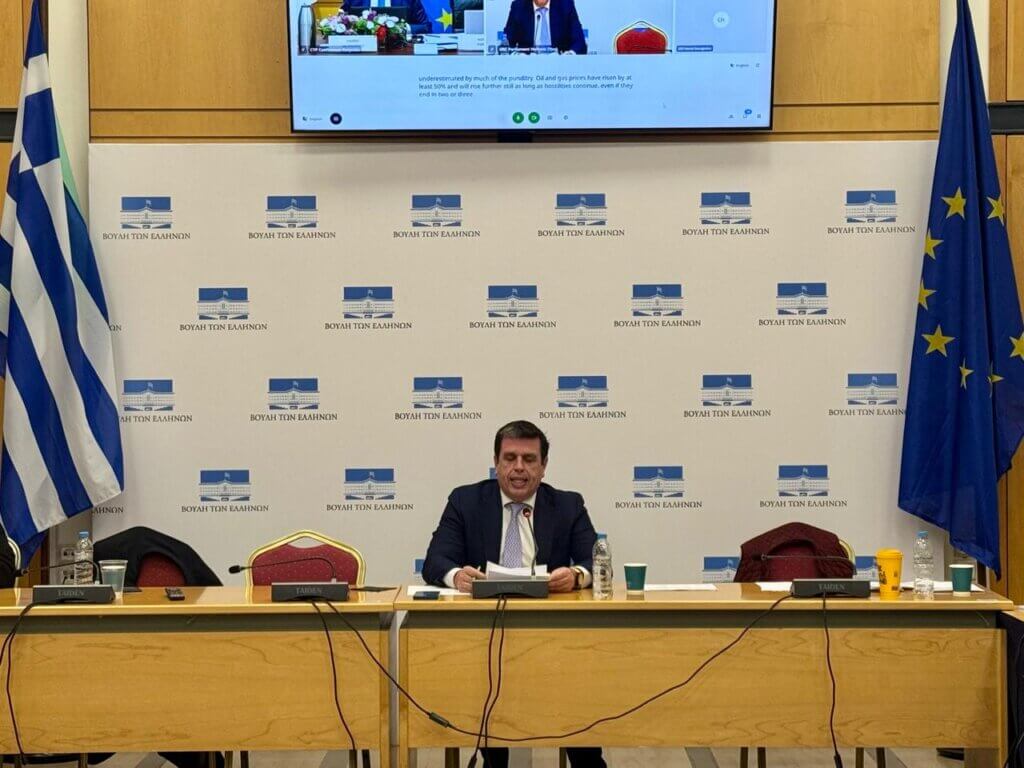
Ομιλία του Δημήτρη Καιρίδη, με θέμα «Η ΕΕ και η Κρίση στη Μέση Ανατολή» κατά τη Διακοινοβουλευτική Τηλεδιάσκεψη στο Πλαίσιο της COSAC που διοργανώθηκε από την Κοινοβουλευτική Διάσταση της Κυπριακής Προεδρίας του Συμβουλίου της Ευρώπης, στις 16 Μαρτίου 2026
Dear friends,
We are currently in the third week of the military campaign by US and Israeli forces against Iran, and I will try, in my short intervention, to sketch out where we stand, what the potential scenarios for an endgame to the conflict are, and what the implications are for the EU and the world. The past two weeks have demonstrated the overwhelming military superiority of the US and Israel. However, this might not be enough to avoid a strategic blunder, as the Iranian regime, fighting for survival, has closed the Straits of Hormuz and threatens to keep them closed for as long as it needs, in order to put pressure on the global economy.
The continuous shifting of US strategic goals has made it hard to predict what comes next. It all depends on one man, and one man alone: President Donald Trump, within a governmental apparatus that has been decimated of dissenting voices and professional expertise. Nevertheless, given the improbability of regime change as long as there are no ground forces involved, there are two main concluding scenarios.
The first is an end to hostilities, followed by an agreement between the two sides similar to the one Obama signed in 2015 and Trump withdrew from in 2018: a freeze on Iran’s nuclear and regional ambitions in exchange for the lifting of sanctions. Although this should be the most preferable outcome, it is hard to imagine Trump acceding to what he has so vehemently denounced in the past, while Israel is not interested whatsoever in any kind of negotiated deal with Tehran’s Islamists.
Therefore, a second scenario is more probable, according to which a ceasefire is followed by a low-intensity conflict with periodic breakouts and eruptions of hostilities similar to those in post-1991 Iraq. In this case, a much weakened but intransigent and belligerent Iran continues to threaten the stability of the Gulf emirates and the freedom of navigation in the Persian Gulf.
The consequences for the global economy of the current Iranian crisis are already dire but still underestimated by much of the punditry. Oil and gas prices have risen by at least 50% and will rise further still, as long as hostilities continue. Even if they end in two or three weeks’ time, it will take some time for many Gulf states to restart production and return the market to where it was on the eve of the war. However, Iran has demonstrated its potential to disrupt trade and close the Hormuz, a threat that it will continue to exploit to extract concessions from the Americans. If an underfunded rebel group in Yemen, like the Houthis, has been able to disrupt traffic in the Red Sea and the Suez Canal, one can only imagine the abundant potential for Iran to do the same at Hormuz and beyond.
The consequences for the EU are fourfold. First, economically: as a major importer of fossil fuels, the European consumer is likely to pay a heavy price for the rise in energy prices. This is very unfortunate, as it coincides with enhanced efforts by the EU to rid itself of its addiction to Russian energy sources, at a time when much of its economy was showing signs of recovery and inflation was being tamed.
Secondly, there should be no doubt that the Iranian crisis is a disaster for Ukraine, as it replenishes the much-depleted Russian treasury, which for the first time since the start of the war seemed so weak at the beginning of this year.
Thirdly, depending on what the end result of the current crisis is, there is a risk of renewed hybrid threats, such as mass migratory flows, terrorism, and enriched uranium falling into the wrong hands. These risks will be even greater if Iran disintegrates.
The final consequence is political and has to do with the EU’s role as a strategic player on the world stage. Here the situation is more complicated and the conclusions mixed. On the one hand, the EU was once more ignored and kept in the dark about American intentions, despite the fact that it bears much of the collateral costs of the war in the Gulf. The US made no effort to consult, or even inform, its European allies.
On the other hand, many EU members are reluctant to point this out, just a few months after the Greenland crisis, out of fear of further alienating the current US administration, which continues to sell advanced weaponry, with European funding, and to provide valuable intelligence to Ukraine. As a result, the EU appears, once more, divided.
While all EU countries have declared their non-involvement in the war, some have facilitated the American war effort, while others, like Spain, have refused to do so. In the meantime, the vast majority of European countries have refused Donald Trump’s call to contribute to a military operation to keep the Straits of Hormuz open.
On the contrary, with Greece at the forefront, six EU member states have responded to the aerial attacks against Cyprus by sending forces in and around the island, further underlining European solidarity and the existence of a common European space that needs to be jointly defended. In the meantime, French soldiers were killed and an Italian aircraft destroyed by Iranian attacks.
The EU policymaking process has often been accused of being cumbersome, bureaucratic, slow, and unlikely to result in a clear policy, as it has to reconcile the diverse views of 27 governments. However, given the risks involved in the overly personalized and excessively concentrated, in the hands of one man, American model, there might be some hidden advantages in the European way of doing things that can only be appreciated in juxtaposition.
It seems that at some point diplomacy will be inevitable. And this might be when the European contribution becomes essential if stability is to be restored. By virtue of their historical experience, Europeans can more easily take the long view and understand the need for a political framework if the Middle Eastern predicament is to be relieved. Military violence is not useless, but it is not a panacea as long as it is not complemented by a broader strategic vision. Europe’s role is to remind everyone of this truism and to work as close as possible with its American partner to make it happen.
The current Iranian crisis, which some have named the Third Gulf War, should remind everybody in Europe of the urgency of building up Europe’s strategic autonomy, accelerating the energy transition away from importing fossil fuels from unreliable sources, and strengthening EU structures and procedures so that Europe can better withstand hybrid threats.
Despite the problems, the deficits, and the criticism, sometimes exaggerated, I strongly believe that Europe cannot and will not fail in that endeavor, as it is increasingly being realized that we are faced with an existential threat in a less and less stable world.
👉 Διαβάστε το Δελτίο Τύπου του Γραφείου Τύπου της Βουλής των Ελλήνων